




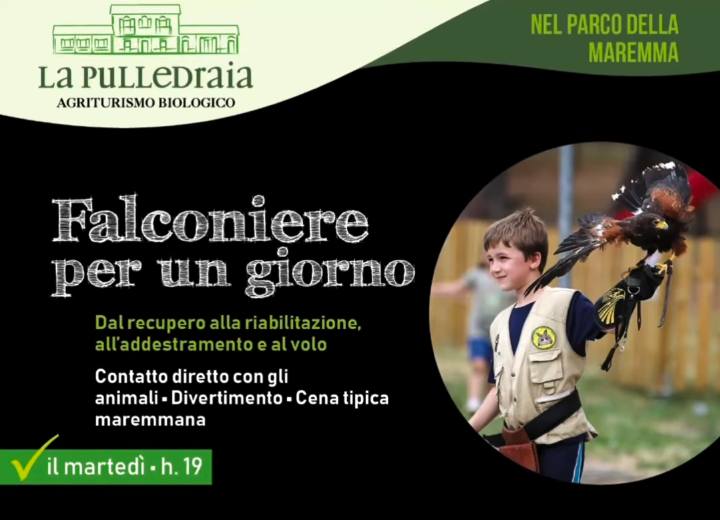
There are experiences that entertain, others that excite, and then there are experiences that change the way we look at nature. Falconer for a day, at the Pulledraia di Alberese, belongs to this third category. It is not a simple flight demonstration, nor a spectacle observed from afar. It is a close encounter with the world of birds of prey, with their trainers and with an ancient tradition, made up of patience, respect, trust and deep knowledge of animals.
In the heart of the Tuscan Maremma, a few steps from the Maremma Park, the evening puts guests in front of a usually invisible world: that of kestrels, barn owls, buzzards and eagle owls. Magnificent, powerful and silent animals, which we are used to imagining free in the sky or hidden among the branches, but which we can rarely observe up close, calmly, under the guidance of those who really know them.
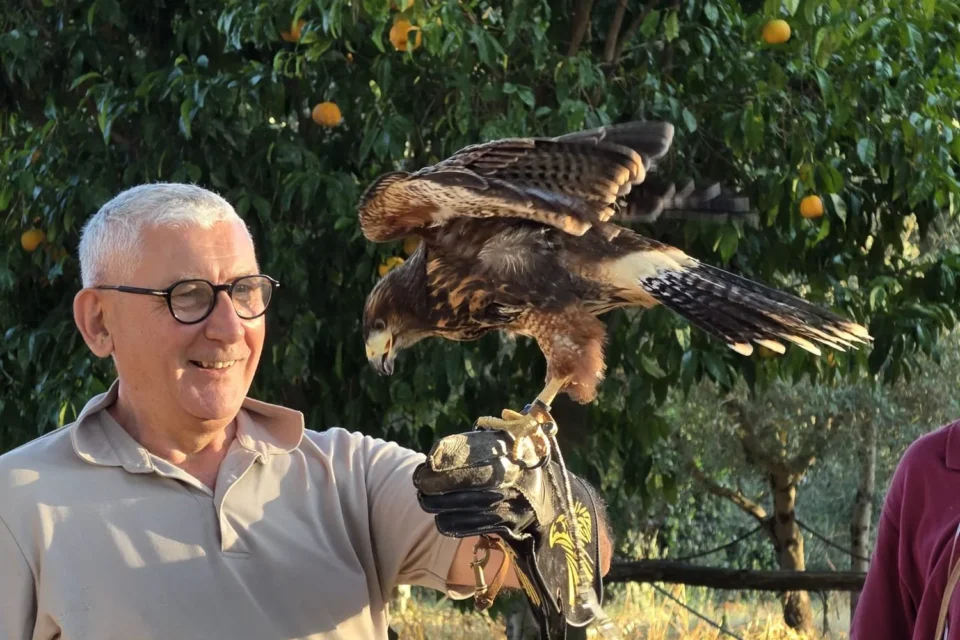
The experience was created to bring adults and children closer to falconry in a safe, engaging and respectful way. The participant does not just look: he can put on the glove, take a bird of prey on his fist, feel its weight, observe the detail of the feathers, meet its gaze and, when conditions allow it and always with the assistance of the instructors, experience the thrill of making it fly.
Indice dei contenuti
An experience in the Maremma Park, between nature and tradition
La Pulledraia is a place that naturally lends itself to this type of activity. The countryside of Alberese, the hills of the Maremma Park, the warm light of summer and the scent of the Mediterranean scrub create an authentic setting, far from the idea of an artificial tourist attraction. Here the relationship with animals is part of everyday life: horses, herds, nature and outdoor work are real elements, not scenography.
Precisely for this reason, Falconiere for a day finds his ideal environment at the Pulledraia. The bird of prey is not presented as an object to be photographed, but as a living being to be known. Before approaching the animals, guests are accompanied in a story that explains who the falconers are, how they work, what relationship they build with their birds of prey and what attention is necessary to ensure safety and well-being.
The evening takes place at a particularly evocative time: the time of sunset. The light becomes softer, the air cools down and the flight of birds of prey acquires a special visual force. Every flap of wings seems sharper, every glide slower, every return to the gauntlet more exciting.
Falconers from 8 to 60 years: a passion that crosses generations
One of the most striking aspects of the experience is the variety of falconers present. There are not only experienced adults, but also very young enthusiasts. Some are as young as eight years old and have learned about birds of prey by following their parents, observing, listening and participating carefully. Seeing them move naturally next to the animals is one of the most beautiful images of the evening.
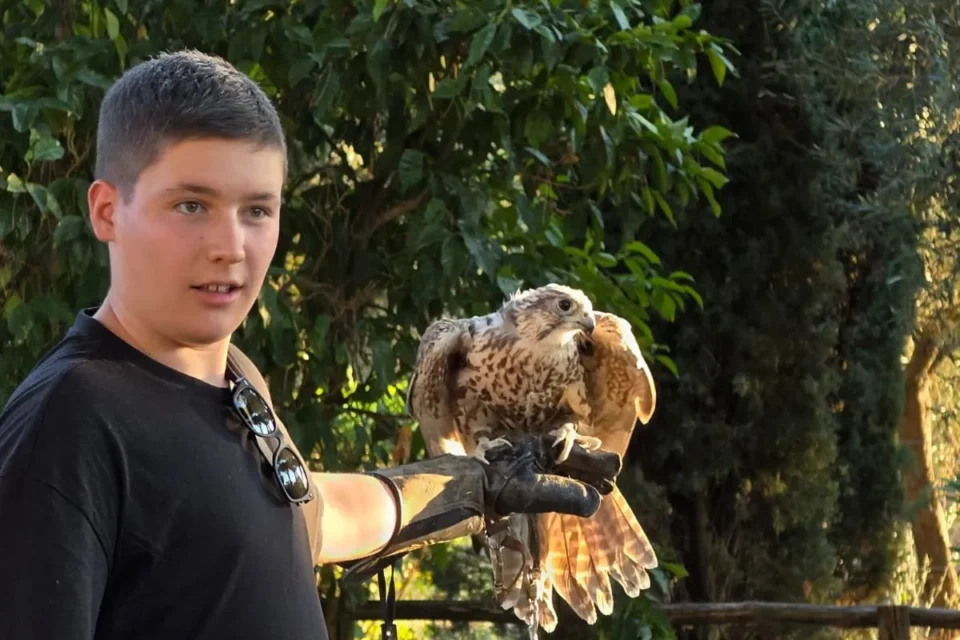
Next to them are mature falconers, some with over forty years of experience. They are people who have dedicated an important part of their lives to falconry, animal rescue, training and dissemination. In their gestures you can see habit, but not superficiality. Every movement is measured. Every word comes from experience. Each animal is presented with respect.
This age difference tells something important: falconry is a passion that is passed on. It is not just a technique, but a language. The younger ones learn by observing the more experienced; Adults convey rules, attention and responsibility. The audience thus witnesses not only an encounter with birds of prey, but also a small passing of the baton between generations.
Kestrels: small birds of prey, great agility
The kestrel is often one of the first birds of prey to surprise the public. He is smaller than the other protagonists of the evening, but possesses an extraordinary grace. Those who observe it closely are struck by the perfect proportion of the body, the very attentive gaze and the speed of the movements.
In nature, the kestrel is famous for its “holy spirit” flight, that ability to remain almost motionless in the air by beating its wings quickly, as if suspended in the wind. Seeing it told by a falconer and then observing it in motion allows you to better understand how specialized this small predator is.
When it gets on the glove, the kestrel immediately makes you feel a different lightness than larger birds of prey. It does not inspire fear, but respect. He is delicate and alert, always ready to observe what is happening around him. For many children it is the first real close encounter with a bird of prey and often becomes one of the most tender moments of the evening.
Barn Owl: the silent flight that enchants adults and children
The barn owl is one of the animals that most strikes the imagination. The light, heart-shaped face makes him immediately recognizable. Up close it appears almost unreal: soft, elegant, silent. But behind this delicate image hides a predator perfectly adapted to nightlife.
One of the most fascinating moments is listening to the falconer explain how the barn owl manages to fly while making very little noise. Its feathers are structured in such a way as to reduce the sound of the beating of wings, allowing it to approach its prey without being perceived. When you see it moving through the air, especially in the low light of sunset, it really seems to appear out of nowhere.
Taking a barn owl on the fist is a very special experience. Its weight is contained, but its presence is intense. The eyes observe, the head moves precisely, the plumage seems to absorb the light. It’s one of those moments when even adults stop talking and just watch.
Buzzards: elegance, strength and great glides
The buzzard conveys a different feeling. It is bigger, more solid, more powerful. Its wide wings immediately tell of its way of experiencing the sky: not a nervous and rapid flight, but a wide, controlled glide, capable of exploiting the updrafts.
When a buzzard starts from the glove, the audience clearly perceives the force of the push. The legs detach, the wings open and the animal immediately takes up space. There is no need for spectacular speed: its presence in the air is enough to capture attention.
Observing it closely also allows us to better understand the role of birds of prey in the natural balance. The falconer can explain how these animals are part of a complex ecological system, how they contribute to the control of small animal populations and why it is important to protect them and respect their habitat.
Eagle owl: the silent giant of the night
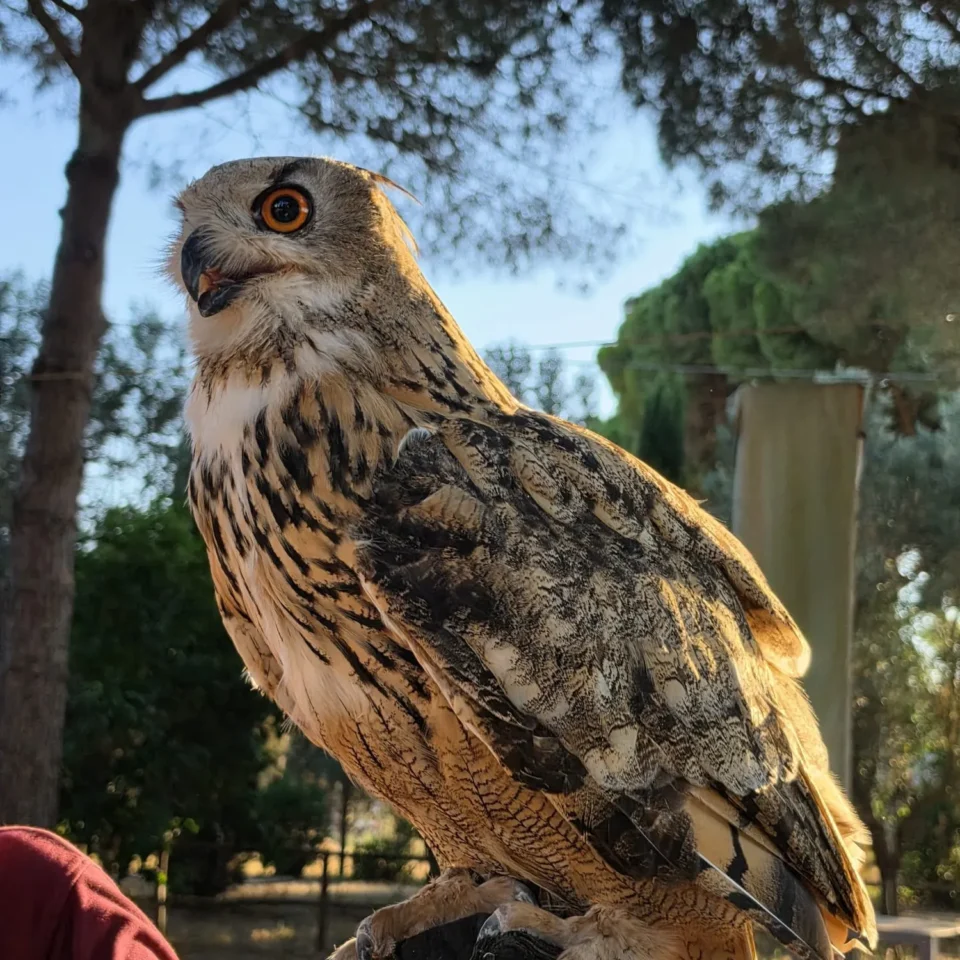
The eagle owl is often the most impressive moment of the evening. Its size, intense eyes, ear tufts and wingspan make it an impactful animal. Even those who have already seen photographs or documentaries are surprised when they find it just a few meters away.
On the falconer’s fist it appears majestic. He doesn’t need to move much to dominate the scene. A movement of the head, a partial opening of the wings or a direct look is enough to make you understand the power of this nocturnal bird of prey. The audience observes him almost in silence, as if in front of something ancient and mysterious.
When the opportunity to approach safely is offered, the emotion is strong. The eagle owl makes you clearly perceive the weight and strength of your body. It is an encounter that leaves its mark, because it makes concrete the greatness of an animal that normally remains hidden from human sight.
The falconer’s glove: safety, respect and trust
One of the central moments of the experience is direct contact with the bird of prey. Everything takes place safely, under the control of the trainers. Guests are instructed on correct behavior: how to hold the arm, how to stay still, how not to make sudden movements, how to respect the animal’s times.
The falconer’s glove is not a simple scenic accessory. It serves to protect the hand and forearm, but it is also the meeting point between man and bird of prey. When the animal lands, you can feel the grip of the claws through the leather. It is not an aggressive gesture: it is the natural way in which the bird of prey seeks stability.
Feeling the weight of a bird of prey on your fist is perhaps the most surprising aspect. Everyone imagines these animals as creatures of air, almost weightless. Instead, when they climb on the arm, they become a concrete presence. You can feel the mass of the body, the strength of the legs, the tension of the muscles, the continuous attention. It is at that moment that the distance between observer and nature is really reduced.
See feathers, eyes, and claws up close
The proximity allows you to discover details that are impossible to grasp from afar. Feathers are not all the same: some are soft and compact, others are firmer, others designed to support flight. The eyes are always in motion and seem to read every detail of the environment. The beak, perfect in its shape, reminds us that they are specialized predators.
The claws are also very striking. They are powerful tools, but in experience they are shown and explained in an educational way, never spectacularized. The falconer helps to understand what they are for, how they are used in nature and why compliance with distances and rules is essential.
For many guests, especially children, this is the moment when a new awareness is born. The bird of prey is no longer a generic animal. He becomes an individual, with his own posture, his own character, his own story. This first-hand knowledge is the first step in learning to really respect it.
The thrill of making a bird of prey fly
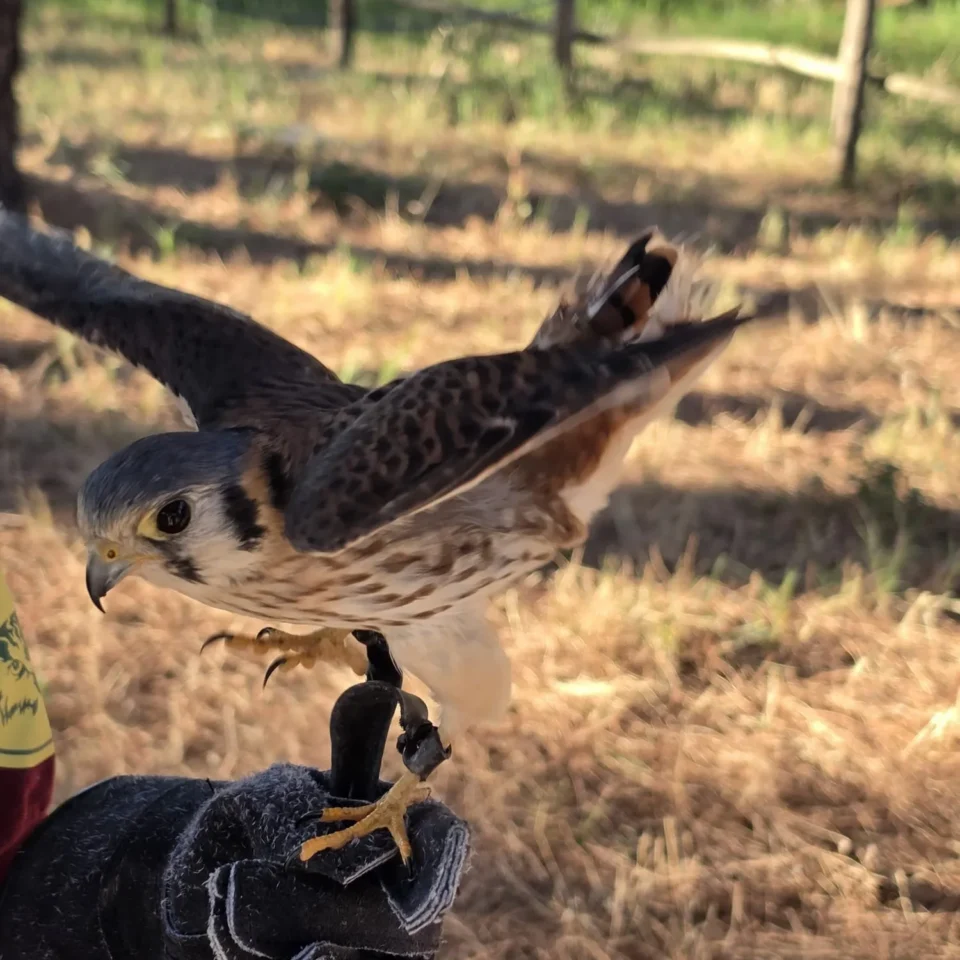
The most awaited moment is often that of the flight. After the explanations, the participant can be invited to collaborate with the falconer to start the bird of prey from the fist or call it back in a guided way. Everything is done with extreme care, evaluating the animal, the context and the safety of the public.
When the bird of prey decides to leave, the emotion is immediate. First, a small tension is felt in the animal’s body. Then the legs push on the glove, the wings open and the weight disappears from the arm. In an instant, what was close becomes flight.
It is difficult to explain the feeling to those who have not experienced it. There is amazement, because everything happens quickly and naturally. There is wonder, because the animal moves with a precision that seems impossible. And there is also a form of gratitude, because for a few seconds you have the feeling of having entered into a relationship with something free and wild.
Environmental education and recovery of birds of prey
Falconer for a day is also an educational experience. Falconers tell the story of the path that leads a bird of prey to be managed, trained or, when possible, recovered and rehabilitated. They talk about injured animals, human errors, accidents, treatments and long times. Not everything is simplified: it is clearly explained that working with these animals requires competence and responsibility.
This aspect is very important, because it helps to overcome the idea of the bird of prey as a simple attraction. Every animal has specific needs. Each species has different behaviors. Every intervention must be done with respect for his well-being. Falconry, when practiced seriously, is not dominion over the animal, but knowledge of its nature.
Guests thus learn to recognize the value of birds of prey in the environment, the role of conservation and the importance of not disturbing wildlife. For children it is a concrete lesson, much more effective than many theoretical explanations: seeing an animal up close, listening to its story and understanding its fragility creates a deep memory.
Dinner at sunset: genuine flavors and views of the hills
After the meeting with the birds of prey, the evening continues with a dinner based on farm products and local flavors. It is a natural step: after experiencing the thrill of flying, guests can stop, breathe, talk and share the images and sensations they have just collected.
Dinner takes place outdoors, in view of the hills of the Maremma Park, pampered by the setting sun. The warm evening light, the open landscape and the simplicity of the flavors create a relaxed, deeply Maremma atmosphere. It’s not just a meal: it’s the completion of the experience.
Here the story continues spontaneously. Children talk about the eagle owl, adults comment on the silent flight of the barn owl, some look at the photos taken, others ask questions to the falconers. Dinner thus becomes a convivial moment, in which emotion settles and becomes memory.
Why choose Falconiere for a day at La Pulledraia
In Maremma there are many things to do: sea, villages, excursions, tastings, horseback riding. Falconer for a day stands out because it combines different elements in a single evening: nature, animals, education, emotion, direct contact and outdoor dinner.
It is an experience that speaks to the heart and curiosity. It allows you to discover animals that you can rarely see so closely, but it does so with a respectful and guided setting. He does not seek the easy effect: he builds wonder through knowledge.
At Pulledraia, moreover, all this takes place in an environment consistent with the spirit of the experience. The agricultural context, the proximity to the Maremma Park, the presence of animals and the family dimension of the welcome make the evening more real. Those who participate do not have the feeling of witnessing something artificial, but of entering an authentic world for a few hours.
An ideal activity for families, couples and nature lovers
The experience is suitable for different audiences. Families find an engaging activity for children, capable of combining fun and learning. Couples experience an original, intimate evening that is different from the classic tourist proposals. Nature lovers have the opportunity to delve into the behavior of extraordinary animals in an authentic setting.
You don’t need to have previous skills. You don’t need to know falconry, nor to have experience with animals. Just arrive with curiosity and willingness to listen. The falconers accompany each phase with simple and clear explanations, adapting the story also to the presence of children.
It is precisely this accessibility that makes Falconiere for a day one of the most interesting experiences to live in Maremma during the summer. It’s exciting, but not extreme. It’s educational, but not boring. It’s spectacular, but without losing authenticity.
Useful information
The Falconer for a day experience at the Pulledraia takes place in July and August, on Tuesdays, starting at 7 pm. The formula includes a meeting with falconers and birds of prey, a guided demonstration, safe contact with the animals and a final dinner with farm products.
It is recommended to book in advance, especially during the busiest summer periods. The activity is also suitable for children, who can participate in compliance with the instructors’ instructions. Comfortable clothing suitable for an evening outdoors is recommended.
The place of the experience is La Pulledraia, in via del Molinaccio 10, Alberese, Grosseto, in the heart of the Maremma and near the Maremma Park.
A memory that remains
At the end of the evening, what remains is not only the photograph with a bird of prey on its fist. What remains is the memory of a glance, of the sudden weight on the arm, of the rustle of the wings, of the silence of the barn owl, of the majesty of the eagle owl, of the agility of the kestrel and the quiet strength of the buzzard.
There is also a new awareness: nature is closer than we think, but to really encounter it we need respect. Falconer for a day teaches just that. It brings us closer to birds of prey without trivializing them, it allows us to get excited without forgetting responsibility, it makes us experience flight not as a show, but as a relationship.
For those looking for an authentic experience in Maremma, different from the usual summer activities, this evening at the Pulledraia is a proposal capable of combining wonder, culture, nature and conviviality. An encounter to be experienced with open eyes and with the heart ready to be surprised.
BECOME A FALCONER FOR A DAY
Available in July and August • Limited Places
FAQ
-
Where does Falconer for a day take place?
The experience takes place at Pulledraia, in Alberese, in the province of Grosseto, in the natural context of the Maremma and near the Maremma Park.
-
What birds of prey can you meet?
During the evening you can meet kestrels, barn owls, buzzards and eagle owls, presented by their falconers.
-
Can children participate?
Yes, the experience is also suitable for children, always in compliance with the safety instructions provided by the instructors.
-
Can you take a bird of prey on the fist?
Yes, under the guidance of falconers and in safe conditions, guests can experience the thrill of holding a bird of prey on their glove and observe it up close.