




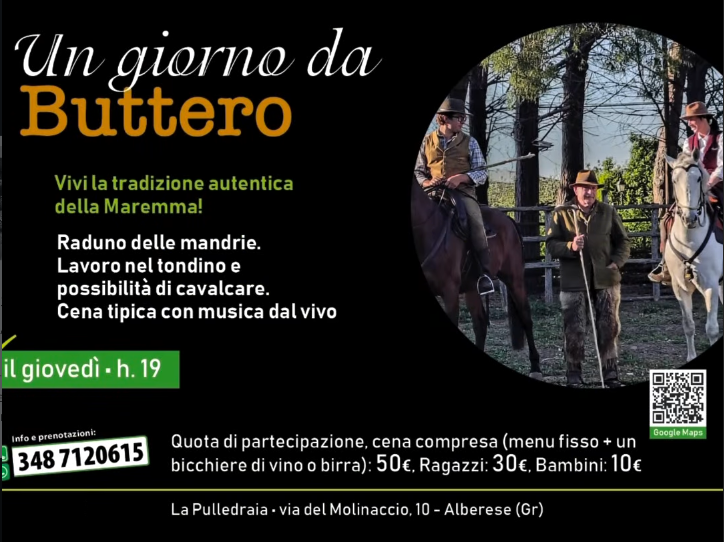
There are experiences that can be told with a program: a start time, a succession of activities, an end time. Then there are others that escape any scheme, because what remains in the heart is not the sequence of events, but the way in which one felt while everything was happening.
Un Giorno da Buttero, at the Pulledraia di Alberese, is one of these.
It is not just an equestrian demonstration. It is not an event built for the tourist. It is an opportunity to enter, even if only for one evening, a world that normally remains hidden. A world made up of men, horses, herds, stories and traditions that continue to live every day in Maremma, away from the spotlight.
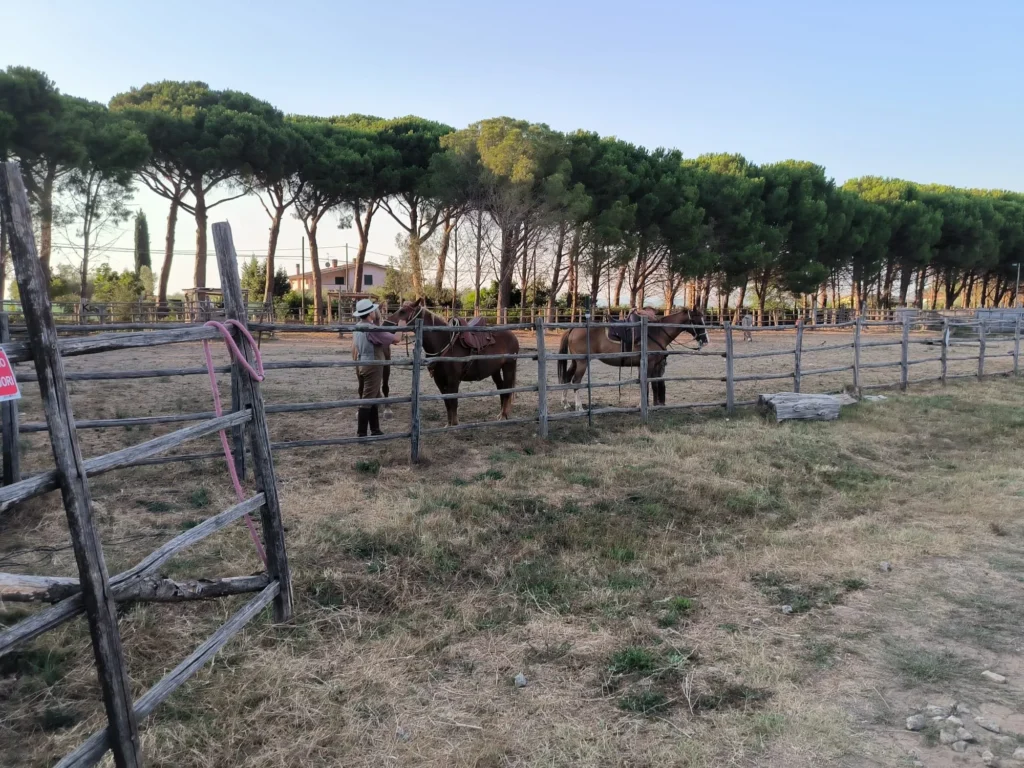
A Day at Buttero’s: an evening when the Maremma opens its doors
When guests arrive at the Pulledraia the sun is still high, but its light has already changed color. The hills of the Maremma Park are slowly tinged with golden shades, the wind crosses the olive trees and brings with it the scent of the earth, hay and Mediterranean scrub. Some walk observing the horses in the enclosures, others stop to photograph the landscape, while the children watch with curiosity every movement of the animals.
The atmosphere is relaxed. No one is in a hurry.
You almost get the feeling that the countryside is waiting for something.
Then, suddenly, a sound comes.
It is far away, almost imperceptible.
They are the clogs. First one. Then many.
Conversations stop spontaneously. The gaze is directed towards the pine forest. No one should ask for silence. It is nature itself that calls attention.
The first silhouettes of the horses slowly emerge. Behind them appear the Maremma cows, with their large horns silhouetted against the sunset sky. The herd advances calmly, accompanied by a cloud of dust that the light makes almost golden. It is a scene that seems to belong to another era, yet it takes place before the eyes of the guests, real, authentic, without special effects.
At that moment it is understandable why the buttero has become one of the symbols of the Maremma.
Not for clothing. Not for the horse.
But for the deep relationship he manages to build with animals and with this land.
Accompanying the public on this journey is Alessandro Zampieri, historic Head Buttero of the Alberese Regional Company. He doesn’t speak like a guide reciting a script he has learned by heart. He tells with the simplicity of someone who really lived that life. Each episode is born from a personal memory, each explanation is the reflection of years spent among horses and herds. His words do not interrupt what happens in front of the guests’ eyes, but make it even more meaningful.
Heidi Mayer, a cowboy from Pulledraia, and Alberto Lazzarin, a cowboy from Terre di Sacra in Capalbio, work alongside him. While Alessandro tells, they are already at work. No loud orders are needed. All it takes is a gesture, a change of direction of the horse, a position chosen with precision. The herd responds naturally, as if that silent dialogue had always existed.
This is what surprises first-time visitors the most.
One imagines a work made up of strength, speed, commands. Instead, a balance of calm, observation and respect is discovered. The animals are not forced. They are accompanied. And the horses seem to understand what the cowboy wants even before the movement is completed.
The audience watches in silence.
Someone smiles. Someone looks at their children, trying to understand if they too are experiencing the same emotion.
Many people lower their phones after taking a few photographs. Because there are images that no photograph can really tell.
The arrival of the herd is one of them.
When a profession becomes a story
As the herd slowly reaches the field, Alessandro Zampieri continues to speak without ever stealing the show from what is happening. His words follow the rhythm of the animals, recounting episodes experienced in the years spent as Head Buttero of the Alberese Regional Company. These are not anecdotes prepared to entertain the public, but fragments of a life spent on horseback, made up of days that began at dawn, calves to be rescued, sudden storms and long rides in the pastures of the Maremma.
Every now and then he stops, points to a horse, observes a movement of the herd and smiles. “Look at what’s going on,” he says, inviting guests to observe a detail that, until a few moments before, would have gone unnoticed. So the audience begins to see the scene with different eyes. He no longer observes only horses and cattle, but discovers a language made up of attention, times and small gestures that tell of a relationship built over the years.
Heidi Mayer and Alberto Lazzarin work naturally. They move to the sides of the herd, leave time for the animals to choose the right direction, intervene only when necessary. There is no search for the spectacular effect. It is precisely this simplicity that strikes the viewer. You can feel that what happens in front of the public’s eyes was not invented for a demonstration, but comes from the daily experience of people who really live this job.
The joint: precision, trust and understanding
When the herd is gathered, the attention shifts to one of the most awaited moments of the evening: the joint.
For those who don’t know him, it’s a curious word. For cowboys it is one of the most important work tools to check the state of health or medicate a cow or treat a horse safely. Alessandro shows its use with the simplicity of someone who wants to share knowledge, not give a lesson. He tells how this technique was born from daily work with the herd and how it requires calm, concentration and perfect harmony between the cowboys in order not to take risks.
The carousel of horses
After the demonstration with the joint, the atmosphere changes again. The cows are left to their pastures and the horses remain the protagonists: the work leaves room for elegance.
The carousel is a tribute to the beauty of Maremma horsemanship. Heidi, Alberto and Alessandro take turns guiding their horses in harmonious figures, while Alessandro accompanies the audience with his stories, recalling how the horse has always been much more than a means of work. He was a travel companion, an ally, a constant presence in the lives of the cowboys.
The light of the sunset makes everything even more impressive. The manes move lightly in the wind, the ground returns the rhythmic sound of hooves and the sky takes on the warm colors of the Maremma summer. No scenographic effects are needed. The landscape already does everything it needs.
Many guests realize that they have stopped looking at the clock. They simply let themselves be carried away by what they are experiencing. This is perhaps one of the most valuable aspects of the experience: for a few hours the time seems to follow the rhythm of the countryside, not that of everyday life.
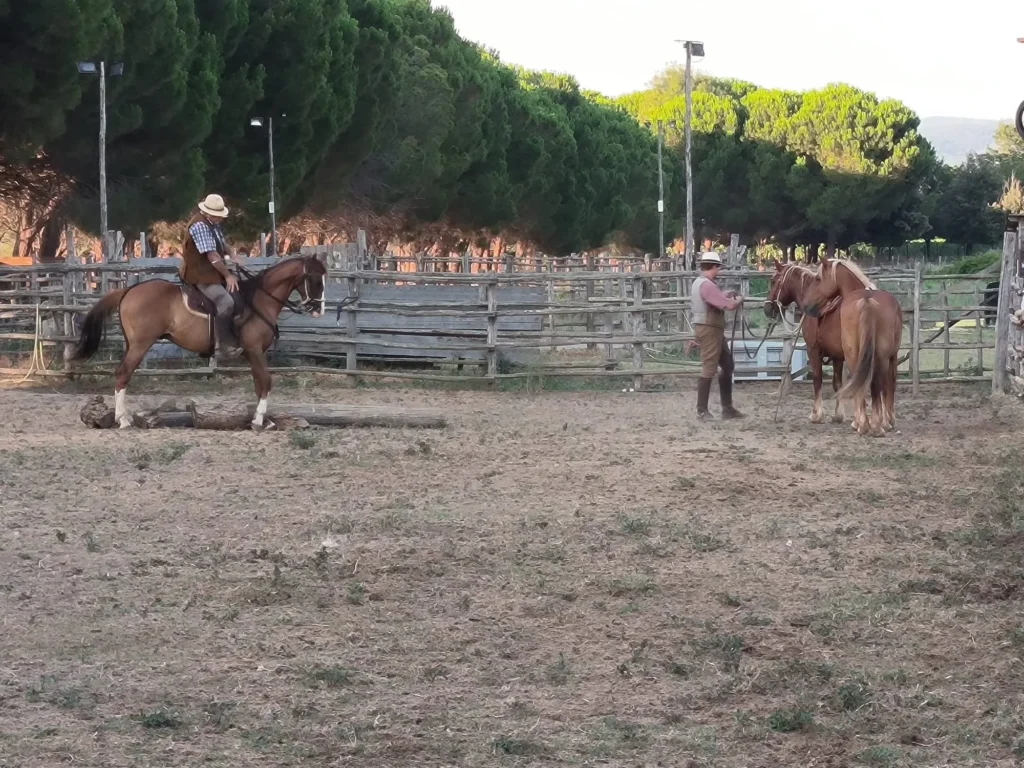
When the audience becomes the protagonist
At the Pulledraia the evening does not end with applause. Indeed, it is precisely at this moment that many guests discover that they can live a small part of the experience firsthand: you can try to be Butteri for a day.
The first to enter the rod are the children. The emotion is already evident while waiting for one’s turn. There are those who shake their parents’ hands, those who observe the horse with a mixture of curiosity and respect, those who can’t wait to get on the saddle. When the horse finally starts moving, the smiles speak for themselves. For many of them it is the first close encounter with such a large and fascinating animal, a memory destined to remain over time.
Then comes the time of the adults.
Those who wish can test themselves in the rod and experience, for a few minutes, the thrill of approaching the work of the cowboy. It is not a question of demonstrating particular skills. It is an opportunity to understand how important dialogue with the horse is, how calm, patience and listening matter. Often this brief moment is enough to give rise to an even deeper respect for those who dedicate their lives to this profession.
Alessandro observes with a smile, intervenes with advice, encourages without ever replacing those who try. Heidi and Alberto accompany each participant with the same attention they give to their horses. No one is judged. Everyone is invited to live an experience that, even if it lasts a few minutes, leaves a feeling that is difficult to forget.
Dinner: when tradition continues around the table
When the horses are let free, the evening does not end. It simply changes pace.
Guests reach the large table overlooking the hills of the Maremma Park while the sky slowly passes from the red of sunset to the first shades of evening. The air is cooler, the landscape is filled with the song of crickets and, looking towards the Maremma Park, you have the feeling that time has slowed down.
The table, in Maremma, has always been the place where the stories continue. It is here that the day’s work is transformed into a story, where the efforts are shared and memories pass from one generation to the next.
The same thing happens at Pulledraia.
While the guests take their seats, the scents of tradition come from the kitchen. The pici, prepared according to the Tuscan recipe, are served steaming. Shortly afterwards comes one of the symbolic dishes of Maremma cuisine: the Maremma cow stew, cooked slowly until it becomes very tender, accompanied by the simple flavors of a cuisine that does not need special effects because it tells the story of this land through genuine ingredients.
Those who come from outside discover new flavors. Those who already know the Maremma instead find tastes that speak of family, countryside and Sundays spent together.
But just when dinner seems to be the natural epilogue of the evening, something happens that changes the atmosphere once again.
The first notes of an accordion begin to spread among the tables.
They are not background music. They are an invitation.
The voice of the Maremma
With the accordion in his hands and the smile of someone who knows the value of being together, Dino Simone accompanies the whole dinner with folk songs and stornelli of the Maremma tradition.
His is not a performance distant from the audience.
It is a presence that slowly enters the evening, as it once happened in village festivals and peasant vigils.
The songs tell of work in the fields, loves, friendships, the irony typical of the Maremma people. Some guests listen in silence. Others start beating time with their hands. Someone smiles, recognizing a tune he had already heard as a child.
Then Dino involves the audience.
One song after another, the distance between those who sing and those who listen disappears.
There are those who try to accompany the chorus, those who let themselves be carried away by the joy of the company and those who simply observe the scene with the satisfaction of feeling part of something authentic.
It is not difficult to imagine how the evenings in the Maremma countryside must have spent many years ago.
They were probably not very different. A shared table. An accordion. A few voices joining in the singing. The pleasure of being together without haste.
It is precisely this simplicity that makes the end of the evening special.
A memory that goes beyond photographs
When it comes time to say goodbye, no one has the feeling of having simply witnessed a show.
We return to the parking lot calmly, continuing to talk about the herd, the horses, Alessandro’s stories, the happy children after their horseback ride, the test in the round, the music and the dinner.
Someone turns once again towards the pastures, now shrouded in darkness.
In the distance you can barely make out the silhouettes of the horses. The accordion continues for a few more minutes. Then only the silence of the countryside remains.
It is at that moment that many realize that they have experienced something rare.
The Maremma has not been told. It was lived.
And this is perhaps the deepest meaning of Un Giorno da Buttero.
Not to turn the work of the cowboys into a show, but to open, for one evening, the doors of a world that continues to exist every day, with the same passion, the same respect for animals and the same bond with this land.
Those who return home will take many photographs with them.
But the best memory will probably be another: the sound of hooves in the golden dust of the sunset, the voice of Alessandro Zampieri who tells of a life spent on horseback, Heidi Mayer and Alberto Lazzarin who naturally lead the herd, the smile of the children after their first ride on horseback and the stornelli of Dino Simone who accompany a shared dinner under the sky of the Maremma.
Because there are places that you visit. And then there are places that continue to be remembered long after returning home.
The Pulledraia is one of these.
BECOME A BUTTERO FOR A DAY
Every Thursday in July and August, 7:00 pm • Limited Places
FAQ
Where does “Un Giorno da Buttero” take place?
The experience takes place at the P-Ranch of the Organic Farmhouse La Pulledraia, in Alberese, in the heart of the Maremma Park.
When does the event take place?
Every Thursday in July and August, starting at 19:00.
Is it necessary to know how to ride a horse?
No. The experience is designed for everyone.
Can children participate?
Yes. The little ones can experience the thrill of a horseback ride in the round, accompanied in total safety.
Can adults try to be a cowboy?
Yes. At the end of the demonstration, some volunteers can test themselves in the rod, followed by the cowboys.
Who leads the evening?
The evening is coordinated by Alessandro Zampieri, historic Head of the Buttero of the Alberese Regional Company, who accompanies the audience with stories taken from his experience.
Who are the other cowboys present?
The experience sees the participation of Heidi Mayer, cowboy of Pulledraia, and Alberto Lazzarin, cowboy of Terre di Sacra in Capalbio.
What animals can you see?
During the evening you can closely observe Maremma horses and cows engaged in work with the herd.
What does dinner include?
Dinner offers traditional dishes prepared with products from the farm, including pici and Maremma cow stew.
Who accompanies dinner with music?
Throughout the dinner Dino Simone animates the evening with the accordion, folk songs and stornelli of the Maremma tradition, involving guests in a convivial atmosphere.
Is a reservation necessary?
Yes, reservations are required and recommended in advance, especially in the summer months.
Who is this experience recommended for?
For families, couples, groups of friends, horse enthusiasts and for those who want to get to know the most authentic Maremma through its traditions.